
- Goodbye to the full check – the Social Security Administration will begin withholding 50% of SSI for accrued debts;
- ‘I’m basically having a panic attack right now’; Manvel wrangles with tightening budget;
- Mayor John Whitmire removes members of LGBTQ board after one member repeatedly requested meetings;
- Lina Hidalgo’s censure marks first time a sitting Harris County Judge is formally admonished;
- ICE: Houston-area Trump-themed burger joint owner now facing deportation;
- Online Hate Speech Resembles Mental Health Disorder Language;
- Conservative and Liberal Brains Might Have Some Real Differences;
- Investigating Extremist Brains and Building Cognitive Resilience;
- What Supreme Court justices said about gerrymandering;
- JB Pritzker Reacts to Possibility of FBI Arresting Texas Democrats;
- A Historic Azerbaijan–Armenia Peace Deal and the Corridor That Changes Everything;
- Iran threatens planned Trump corridor envisaged by Azerbaijan-Armenia peace deal;
Now in our 12th year on KPFT!
FYI: WordPress is forcing me to work with a new type of editor, so things will look … different … for a while. I’m hoping I’ll improve with a learning curve. Please bear with me, and let me know of any odd glitches you see that I may not, so I can try to fix them. — Mike
Beginning April 20th, Thinkwing Radio will air on KPFT 90.1-HD2 on Sundays at 1PM, and will re-air on Mondays at 2PM and Wednesdays at 11AM. Thanks for listening!
AUDIO:
Thinkwing Radio with Mike Honig (@ThinkwingRadio) is now on Sundays at 1PM and re-runs Wednesday at 11AM (CT) on KPFT 90.1 FM-HD2, Houston’s Community Media. You can also hear the show:
- Live online at KPFT.org (from anywhere in the world!)

Please take a moment to choose THINKWING RADIO from the drop-down list when you donate.
- Podcast on your phone’s Podcast App
- Visiting Archive.KPFT.ORG
- An educated electorate is a prerequisite for a democracy.
- You’re entitled to your own opinion, but not your own facts.
Except for timely election info, the extensive list of voting resources will now be at the end.
“There’s a reason why you separate military and police. One fights the enemy of the State. The other serves and protects the People. When the military becomes both, then the enemies of the State tend to become the People.” ~ Commander Adama, “Battlestar Galactica” (“WATER”, Season 1 episode 2, at the 28 minute mark.)
Welcome to Thinkwing Radio with Mike Honig on KPFT Houston at 90.1-HD2, Galveston 89.5-HD2, and Huntsville 91.9-HD2. KPFT is Houston’s Community Media. On this show, we discuss local, state, national, and international stories that may have slipped under your radar. At my website, THINKWINGRADIO-dot-COM, I link to all the articles I read and cite, as well as other relevant sources. Articles and commentaries often include lots of internet links for those of you who want to dig deeper.
This begins the 10th week of Trump’s military occupation of Los Angeles and the 6th week of his deployment of Marines to his “Alligator Alcatraz”.
- In the nature of a Public Service Announcement — Goodbye to the full check – the Social Security Administration will begin withholding 50% of SSI for accrued debts; by Rita Armenteros | BLANQUIVIOLETAS.COM [a Spanish news site] | 07/28/2025 07:00. TAGS: Supplemental Security Income (SSI), Social Security Disability Insurance (SSDI), Social Security Administration (SSA), Overpayment Recovery,
- In the United States, Supplemental Security Income (SSI) and Social Security Disability Insurance (SSDI) payments will suffer cuts of up to 50% by the Social Security Administration. However, these cuts will apply to those who have outstanding benefit overpayments.
- [MIKE: In other words, just like if a bank accidentally gives you too much money, you’re responsible for giving it back. Annoying, but totally legal. Continuing …]
- It should be noted that this measure is part of the recent plan being promoted by the new government. It should also be noted that the Cost-of-Living Adjustment will not be affected in the first instance, but monthly checks will undergo changes. Along the same lines, those affected will be able to consult all the information regarding their payments on [SSA].gov and will be able to manage it without any inconvenience.
- … Starting July 24, 2025, the Social Security Administration (SSA) will begin applying automatic cuts of up to 50% on SSI payments for those who received more money than they were entitled to and have not paid off their debt or agreed to a payment plan.
- [MIKE: This article then provides a helpful link:]
- If you are among the SSI or Social Security beneficiaries who have an outstanding overpayment, starting on that date, you will see your monthly check reduced while the SSA recovers the funds. The measure is part of a stricter recovery plan launched this year.
- The SSA will reduce SSI checks by 50% for those who owe overpayments
- The new adjustment announced by the SSA seeks to recover billions of dollars in accumulated overpayments. According to official records, approximately 2 million people were notified in the last fiscal year that they had received more than they were entitled to in monthly benefits.
- If you receive retirement, SSDI, or SSI payments and have an outstanding balance, you should know that the 50% withholding will be applied automatically starting at the end of July, approximately 90 days after receiving the official overpayment letter. For example, if your monthly benefit is $1,200, starting July 24, you may receive only $600 until the debt is paid off.
- This cut applies even if the overpayment was not your fault. It is important to review any notifications you have received since April because the SSA is sending these notices in advance to allow you to take action before the deduction begins.
- [You can] negotiate or request exemptions from the SSA in light of these cuts
- If you cannot afford to have 50% of your monthly benefit withheld, the SSA allows you to request alternative payment plans or exemptions. To do so, you must prove that the overpayment was not your responsibility, that you cannot afford to make the repayment, or that recovery would be unfair in your financial situation.
- Requests can be made directly through the official SSA.gov portal or at your local office. In addition, voluntary debt payments can be made online, by credit card, or by check to prevent automatic withholding from being activated. Remember that this policy does not affect all beneficiaries: only those who have received a formal notice of overpayment and have not yet resolved their financial situation with the agency.
- … If you have no outstanding debts, your monthly check will continue to arrive as normal according to the usual schedule. …
- To avoid surprises, it is essential that you keep your information up to date on SSA.gov and review all official communications sent to your registered address.
- This will allow you to confirm whether you are among the affected beneficiaries and, if necessary, take timely action to file an appeal or request a reduction in the monthly deduction.
- MIKE: There is a bit more information and helpful links in the story. You can click on the article link in this show post.
- Unless you live in Manvel, some of you may wonder why I’m taking time on the following story. After I read it, I’ll tell you what got me interested — ‘I’m basically having a panic attack right now’; Manvel wrangles with tightening budget; By James T. Norman | COMMUNITYIMPACT.COM | 4:03 PM Aug 7, 2025 CDT/Updated 4:03 PM Aug 7, 2025 CDT. TAGS: Manvel (TX), City Budget, Property Taxes,
- Despite more projected revenue, including sales tax revenue potentially almost tripling, Manvel’s newest budget is projected to be tighter than last year due to several new expenses the city is incurring.
- Officials at an Aug. 4 meeting discussed the city’s new fiscal year 2025-26 budget and set the maximum tax rate the city can work with ahead of approvals in the coming months.
- … The city set that rate at $0.58 per $100 valuation of a home, which is up from the no-new-revenue rate of $0.539339, documents show. The approval means the city is allowed to approve a lower rate but cannot set a higher one at a later date.
- However, Mayor Dan Davis [said on Aug. 7 that] city staff is expecting the council to ultimately approve a tax rate of $0.56, which would keep the tax rate flat compared to last year.
- [MIKE: Just to clarify, that is not an adjusted rate for inflation. I checked, and that is the real rate for the 2024-2025 fiscal year. Continuing …]
- That rate, if approved at a future date, will mean a total annual tax bill of $1,680 for a home valued at $300,000, officials said.
- The preliminary total budget projects a balanced budget, with total revenues and expenses sitting at $17.4 million, documents show. This compares to a total budget in FY 2024-25 of $15.79 million.
- [MIKE: In short, that means that even at the prior year’s tax rate, Manvel’s taxable property values have increased about 10%. Continuing …]
- However, those totals do not include many key items. City staff, for example, identified 40 new positions — totaling $3 million — that were needed to maintain the same level of city services as the current year. The current budget includes none of those new positions.
- In another area, out of 43 additional requests, such as equipment, three are included. The remaining 40 requests would cost $3.5 million, documents show.
- … Council member David Lands noted that last year, when the tax rate was also at $0.56 per $100 valuation, city staff was able to add several new staff members; a 5% cost-of-living adjustment, or COLA, for staff; 17 supplemental requests totaling $1.6 million; and a new homestead exemption.
- City Manager Dan Johnson said new expenses, such as the new police facility, water treatment plant, and the payroll,which includes 114 employees, add up.
- [Lands said,] “Something happened. I’m basically having a panic attack right now. We did all that last year at $0.56, and we can’t do anything this year.”
- Some highlights in the preliminary budget, according to city documents, include: The city’s overall net taxable value went up from $2.1 billion to $2.3 billion; 1,000 new properties were added to the tax rolls; [and a] 3% COLA [Cost-of-Living Adjustment] for all full-time employees.
- The city is also projecting an additional $3.3 million in sales tax revenue, which would represent a 276% increase from last year. City Manager Dan Johnson said they attribute that increase predominantly to the new Lowe’s Home Improvement store set to open later this year.
- Officials said every additional penny added to the tax rate provides an additional $185,000 in revenue for the city.
- … Part of the discussion Aug. 4 was how to find more revenue. Davis said Aug. 7 that lowering the fund balance and having the Manvel Economic Development Corporation cover a $400,000 payment for the city’s new water reclamation facility could free up around $1.5 million.
- [Council member Keith Bonner said at the meeting,] “I’m just looking at a couple of ways we can find funds without having to increase taxes.”
- … Davis highlighted the difficulty of the budget cycle but highlighted some of the developments the city has had recently, such as opening up its new police station.
- [Davis said,] “It’s difficult times. It’s tough times. It’s not for the faint of heart. It’s tough. … [The budget] weighed heavily on my heart. … When I was struggling with sleepless nights over this weekend about this budget, I did take time to reflect on how far we’ve come.”
- … The council voted to postpone a vote on a potential utility rate increase, as members were looking for more information before voting.
- Documents show the rate for water and wastewater in the city would increase by 11.2%. Prior to going into effect, it would need approval at two separate meetings.
- The preliminary budget includes this increase as an assumption, according to city documents.
- … The city will hold a budget town hall Aug. 20, Davis said. Following that, a public hearing and initial approvals, the final approval of the budget could come either Sept. 15 or Sept. 18.
- MIKE: First, if you want to know more about the Texas tax revenue cap, you can learn about it at the website I’m linking to, called “Property Tax Transparency in Texas”. It’s a Texas state website, so it may be equal parts information and propaganda.
- MIKE: This story about Manvel is another example of Texas having made itself a flat-tax state that favors the wealthy, and financially most harms the less affluent members of any given community.
- MIKE: I think it’s worth noting that the discussion I’m about to have with you applies to any and all discussions you’ll see involving economic statistics, which is one reason I decided to talk about the Manvel story. I’ll be embedding links for some of these stats in this show blog at ThinkwingRadio-dot-com.
- MIKE: I did a little research on some statistics for Manvel. As of summer 2025, the average home in Manvel is valued at $448,000 to $610,000, while the median value is about $321,000.
- MIKE: As may be the case with most of you, I always find that a bit confusing, so here is how TheBalanceMoney-dot-com defines it: “The average (or mean) is calculated by summing all numbers in a set and dividing by the count of those numbers, while the median is the middle value in a set that has been ordered from least to greatest. The average can be significantly influenced by extremely high or low values (outliers), whereas the median provides a better sense of the typical value in a dataset because it is unaffected by these extremes.”
- MIKE: About 80% of Manvel residents own their own homes, but numbers vary a bit on either side of that. The price of the average home is dragged upward by the very most expensive homes in Manvel, while the median value is a better example of the almost 13,000 people living there.
- MIKE: Meanwhile, in 2023 (the latest year I have for statistics), the median annual income was just over $49,000 with median household incomes averaging about $114,000. On the other hand, the average (or mean) household income is around $128,677.
- MIKE: Again, the wealthiest earners in Manvel drag that number upward.
- MIKE: What I infer from that is that a property tax increase will harm the majority of homeowners least, while an 11% rate hike on utilities will harm the remaining 20% — the group that mostly can’t afford to own a home — the most.
- MIKE: I understand that there is a lot to debate on either side of this argument. Not all homeowners can financially tolerate a 1 percentage point increase in their property taxes, but I’m suspecting that most can. And I suspect that an 11% increase in utility rates will bother and perhaps stress everyone more every month than a relatively modest annual property tax rate increase.
- MIKE: If you’re a renter, a property tax increase may eventually show up in your rent as either a pass-through or with a markup by the property owner, but it also might not, since most rents are driven by supply and demand, in many cases regardless of underlying owner expenses.
- MIKE: For my money — and remember, my money is involved in this discussion — a progressive state income tax is the fairest solution by far, with the state then meting out funds to cities and counties on some calculated basis, whether per capita, or based on some other mixture of criteria.
- MIKE: As is sometimes said, there are “Lies, damn lies, and statistics.” You can pick your poison, and consider everything I’ve said here for yourself.
- Mayor John Whitmire removes members of LGBTQ board after one member repeatedly requested meetings; By Abby Church, City Hall Reporter | HOUSTONCHRONICLE.COM | Aug 4, 2025. TAGS: Houston Mayor John Whitmire, LGBTQ, LGBTQ Advisory Board, LGBTQ+ Community,
- Houston Mayor John Whitmire has removed members of his LGBTQ Advisory Board after one of its members complained to a local TV station about not being able to get a meeting with the mayor.
- In a July 29 email to current and past members of the board, the mayor’s senior adviser for boards and commissions, Scout Odegaard, wrote that the members’ service was ending immediately.
- [Odegaard wrote,] “As you may know, all board members’ most recent terms of service expired in 2020, and many of you have either been serving in an expired term or may have even stepped back from your role. At this time, we will be appointing a new slate of board members that represent a wide swath of the Houston LGBTQ+ community and ending your term of service effective immediately.”
- [MIKE: I’ll note here that Whitmire has been serving as mayor since January of 2024. So if the board serving expired terms was a problem for him, what has he been waiting for? He obviously terminated these board members just because one of more of them irked him. Before that, he apparently was just ignoring them, which I think was the point of the complaint. Continuing …]
- The board’s former chair, Jacques Bourgeois, told ABC-13 on June 20 about his concerns about his repeated attempts to meet with Whitmire. Bourgeois believes his outspokenness led Whitmire to dump members of the board.
- [Bourgeois said in an interview with the Houston Chronicle,] “It’s absolutely that. Our thing was we need to engage with you, because we’re stuck in a holding pattern. If we can’t move with you, we’re moving against you.”
- In a statement, Whitmire called the board “inactive,” adding that he regularly meets with members of the LGBTQ+ community as an “informal advisory group.”
- [Whitmire wrote in a statement,] “Instead of keeping a large, inactive board, I decided to appoint a smaller, more effective group, and I wanted to give new people the opportunity to serve. The LGBTQ+ community is best served through active, ongoing engagement with me and my administration. My leadership team also includes members of the LGBTQ+ community. Many of those complaining haven’t gotten over the fact that I won the election and am getting a lot of positive things done for the City of Houston.”
- Whitmire added: “The former board wants to play politics. I don’t have time for politics.”
- [I want to point out here how annoyed I am when a politician says this. Note that it is a politician saying it, and they are in politics, and they are in a political position. Thus, by definition, everything they are involved in is literally playing politics! Continuing …]
- In an interview with the Chronicle, Bourgeois said he had requested a meeting with the mayor five or six times since Whitmire took office, but was only able to speak with Odegaard. [Bourgeois said that in] those conversations, Odegaard told him the mayor’s office was looking to refresh the board, [and] that current members would have to re-apply and that she had interviewed around 50 people for board slots … .
- On July 16, an email shared with the Chronicle shows board member David Maly asked Odegaard whether the mayor had decided to replace the board and remove its members following the ABC story. Odegaard responded that the decision to recast the board happened in early June, before the ABC story aired.
- A spokesperson for the mayor’s office also said Odegaard had reached out to the former chair to set up a meeting about candidates for re-appointment but didn’t hear back until she was wrapping up interviews.
- Bourgeois said Odegaard had only reached out to him once even though she has his number, and that her email had gone to his spam folder.
- [MIKE: I’ll point out here that email going to a spam folder is either true, or it’s the new version of ‘the dog ate my homework’. In my case, it’s usually true, but sometimes it just got buried in the usual crush of emails. Continuing …]
- Bourgeois also disputed Whitmire’s claim about the past board’s inaction. Despite not being able to meet with the mayor, Bourgeois said members had continued to meet on their own to connect a council member’s staffer and send out a survey on what the community was looking for from the board.
- In Houston’s strong-mayor form of government, it is routine for mayors to replace city department directors and board appointees installed by their predecessors.
- Bourgeois acknowledged the mayor can do what he wants with his boards. But he said he believed the replacement of the board came as a result of speaking out about not being able to get a meeting. …
- … The Mayor’s LGBTQ Advisory Board was formed under the late former Mayor and U.S. Rep. Sylvester Turner’s administration shortly after the 2016 shooting at Pulse, an LGBTQ+ nightclub in Orlando, that left 49 people dead. Its goal is to serve as a liaison between Houston’s LGBTQ community and the mayor’s office.
- Turner initially appointed 49 members to symbolize the 49 people who lost their lives in the shooting. The board’s maximum capacity is now 23 members, according to the city’s boards and commissions website.
- A spokesperson for Whitmire did not say who would be a part of the new board, but that two people who had previously served on the board would be members.
- The mayor has so far only appointed one person to his revamped LGBTQ Advisory Board — Amegy Bank Vice President Clay Melder, who previously served on the Montrose Center’s community advisory board and as the chair of Amegy’s LGBTQ+ Business Resource Group, according to his online resume.
- [David Maly, one of the board’s recently dismissed] members, said the mayor’s move showed Houston’s LGBTQIA+ community that “you can be here and a part of things as long as you don’t say too much.”
- [Maly said in a statement,] “It defeats the purpose of a board built by the great Mayor Turner to advocate for and expose issues related to this demographic of the community. With current federal policy and judicial efforts, advocacy for LGBTQIA+ people right now is vital.”
- MIKE: While my initial impulse on this story was to call Mayor Whitmire a petty dictator, a full reading shows that the issue is actually more complicated than that. There’s probably some blame on both sides for how this turned out. The question is, how much blame is innocent, and how much is nefarious?
- MIKE: It seems to me that when the term of any member of any board or committee expires, it behooves that person to recognize their expired status, and to inquire what their status will be going forward. I think that by default, their status changes to ‘acting’ member, and I think that the LGBTQ board members should have recognized that and been proactive in clarifying what their new status was going to be.
- MIKE: But it also seems to me that Mayor Whitmire had over a year and a half to get his administration in order, and he was treating the LGBTQ Advisory Board with what can most kindly be described as benign neglect. Perhaps he didn’t care for the board or its members, and rather than replace them, he decided — actively or passively — to avoid the political hit of simply dismissing them.
- MIKE: I think that the board’s former chair, Jacques Bourgeois, knowing that the boards members’ positions had expired almost 5 tears ago, should perhaps have made stronger efforts to clarify the board’s position. He said that he tried, but we don’t really know how persistent he was or what avenues he pursued.
- MIKE: Scout Odegaard, the mayor’s senior adviser for boards and commissions, appears to have made at best a half-hearted effort to contact former chair Bourgeois. A single email is easily missed by anyone, and she or one of her assistants never even picked up a phone to leave a message.
- MIKE: So as I said earlier, there appears to be plenty of blame to go around for this fiasco, but if politics is being played here — which by definition, it is, by all parties concerned — it’s being played very badly, most of all by Mayor Whitmire.
- Lina Hidalgo’s censure marks first time a sitting Harris County Judge is formally admonished; By John Lomax V, Staff Writer | HOUSTONCHRONICLE.COM | Aug 8, 2025. TAGS: Harris County Judge Lina Hidalgo, Censure, Decorum,
- Commissioners voted Thursday to censure Harris County Judge Lina Hidalgo, marking the first time the top executive has been formally admonished in the county’s history.
- The move came after commissioners voted 4-0 on an update to the court’s decorum rules to allow a majority of voting members to formally admonish another for their behavior. Immediately following that vote, commissioners voted 3-1 to utilize the newly created censure mechanism on Hidalgo for multiple decorum breaches during Thursday’s meeting.
- Republican Commissioner Tom Ramsey introduced both motions, but received bipartisan support from Democratic Commissioners Lesley Briones and Adrian Garcia. Ramsey said the official reason for the censure, which is a formal expression of disapproval and does not impose a penalty on Hidalgo, was because the judge swore in front of a 7-year-old child seated behind the dais who was a guest of Ramsey. …
- Ramsey later told KTRH that he would make it his “mission” to remove Hidalgo from office. While the fellow Democrats that voted to censure Hidalgo did not echo Ramsey’s call to remove Hidalgo, Texas’ Local Government Code does provide mechanism for commissioners to remove Hidalgo. Potential grounds for removal include incompetency and misconduct, according to the code. …
- Hidalgo, who had departed the meeting for a scheduled appointment, was not present during the vote to censure her. Her office did not respond to the Houston Chronicle’s request for a response to the admonishment. Hidalgo read aloud from a post she made to X prior to her departure in which she criticized her fellow Democrats for what she saw as their failure to live up to the party’s principals. …
- A chaotic scene erupted earlier in the meeting as Hidalgo goaded dozens of children, who attended the meeting to support the continued funding of a slate of early childcare programs, to call on commissioners to vote in favor of the proposed tax increase. Multiple calls for decorum were ignored by Hidalgo, who repeatedly interrupted commissioners during discussion on the matter.
- Garcia accused Hidalgo of using children for political gain in a statement posted to social media following the spat.
- Although commissioners did not formally vote on the proposed increase, they failed to meet a key deadline, effectively making the motion moot. Garcia and Briones both said that, although they support the spirit of the programs, they felt it was too early to tell whether they were effective or what impact they had.
- Briones labeled the proposed tax increase “half-baked” in a statement published prior to the meeting
- MIKE: I’ve edited out some quotes by the parties involved to stick to the facts of the story. You can read the full article by clicking on the link provided in today’s show post at ThinkwingRadio-dot-com.
- MIKE: I’ve also added a couple of reference links below this story.
- REFERENCES: Lina Hidalgo: No cuts for kids. Let voters decide on funding early childhood education; Opinion, By Lina Hidalgo | HOUSTONCHRONICLE.COM | Aug 6, 2025
- REFERENCES: ‘Wow’ is right. Lina Hidalgo undermines her own push for childcare. | Editorial; Too bad the county judge isn’t a better advocate for a legitimate cause. Early childhood education is a worthwhile investment. —
- By The Editorial Board, Opinions from the Houston Chronicle Editorial Board| HOUSTONCHRONICLE.COM | Aug 7, 2025
- You’re about to go down a rabbit hole with me. It started so innocently — ICE: Houston-area Trump-themed burger joint owner now facing deportation; Author: Cory McCord (KHOU) | KHOU.COM | Published: 4:14 PM CDT August 7, 2025/Updated: 6:10 PM CDT August 7, 2025. TAGS: President Donald Trump, Immigration and Customs Enforcement (ICE), Roland Beainy, Trump-themed burger joints, Houston,
- The owner of President Donald Trump-themed burger joints in the Houston area is facing deportation, according to United States Immigration and Customs Enforcement officials.
- Roland Beainy is a Lebanese immigrant who operates restaurants in and around Houston.
- According to an ICE spokesperson, Beainy, 28, was supposed to leave the country by Feb. 12, 2024. They said he initially entered the country in 2019, but he overstayed his visa.
- The ICE spokesperson said Beainy doesn’t have any immigration benefits that would prevent him from being arrested or removed from the country.
- On May 16, he was arrested and put into immigration proceedings.
- On June 13, an immigration judge granted his request for bond while he waits for the proceedings to unfold.
- [This is the full statement from ICE]:
- “Despite false claims to the contrary, Roland Mehrez Beainy does not have any immigration benefits that prevented his arrest or removal from the United States.
- “Beainy is a 28-year-old illegal alien from Lebanon who entered the United States in 2019 as a non-immigrant visitor, but he failed to depart by Feb. 12, 2024, as required under the terms of his admission. ICE officers arrested him on May 16, 2025, and he was placed into immigration proceedings. On June 13, an immigration judge granted his request for bond while he undergoes his proceedings.
- “Under the current administration, ICE is committed to restore integrity to our nation’s immigration system by holding all individuals accountable who illegally enter the country or overstay the terms of their admission. This is true regardless of what restaurant you own or political beliefs you might have.”
- MIKE: There is a moral to this story. Here’s how I interpret it: “When you lay down with the lion, you don’t make it your friend. You get eaten.”
- MIKE: Beainy is another delusional immigrant who seems to believe that Trump means everyone else, but not him
- MIKE: I’m not sure what to call that on a psychological level. Is it denial? Is it Stockholm syndrome?
- MIKE: Well, I decided to look it up, and Wikipedia says it’s called “internalized oppression”. I’ve linked to it.
- MIKE: The article says in part, “It occurs as a part of socialization in an oppressive environment. Members of marginalized groups assimilate the oppressive view of their own group and consequently affirm negative self-stereotypes.”
- MIKE: Elsewhere in the article is says that another aspect of internalized aggression is, “Internalized racism [which] is about fostering a negative attitude towards one’s own race, created by the oppressing race, and nurturing a positive attitude towards the oppressor’s race (e.g., race traitor).”
- MIKE: There’s much more in the article itself, which I’ve linked to.
- MIKE: In the case of Stephen Miller, Trump’s White House deputy chief of staff and a driving force behind the deportation movement, he’s been called a self-loathing Jew, another term in which the oppressed identifies with the oppressor. In other words, Miller has internalized the racism he’s seen around him and perhaps has been subjected to, and now he participates in it.
- MIKE: I can’t help but feel some schadenfreude at Beainy’s situation, and I guess that makes me a little petty, but the thing is, he’s not all that unusual.
- MIKE: We keep hearing stories like this of, for example, naturalized immigrants who voted for Trump, even though they have family members who could be deported. Of green card holders who supported Trump and then get arrested by ICE.
- MIKE: Those of us who oppose Trump and oppose this Gestapo version of ICE shake our heads and roll our eyes at these stories, but they seem very common.
- MIKE: Is it helpful to know that there’s an actual psychological trait involved here? You tell me.
- This brings me to another article I ran across. I don’t have time to read all of it, but I’ll read the top lines of the article. The story link is in this show post. — Online Hate Speech Resembles Mental Health Disorder Language; Author: Claire Turner | NEUROSCIENCENEWS.COM | July 29, 2025. TAGS: AI, Artificial Intelligence, borderline personality disorder, BPD, brain research, cluster b personality disorders, Deep Learning, hate speech, Machine Learning, mental health, narcissistic personality disorder, neurobiology, Neuroscience, NPD, PLOSPsychology, Neuroscience, Psychology,
- Key Questions Answered
- Q: What did this study find about hate speech and psychiatric disorders?
A: Posts in online hate speech communities show speech-pattern similarities to posts in communities for personality disorders like borderline, narcissistic, and antisocial personality disorder. - Q: Does this mean people with psychiatric disorders are more hateful?
A: The researchers emphasize that they cannot know if users had actual diagnoses—only that the language patterns were similar, possibly due to shared traits like low empathy or emotional dysregulation. - Q: Why does this matter for online safety and mental health?
A: Understanding that hate speech mirrors certain psychological speech styles could help develop therapeutic or community-based strategies to combat toxic online behavior. - Summary: A new study using AI tools found that posts in online hate speech communities closely resemble the speech patterns seen in forums for certain personality disorders. While it doesn’t imply that people with psychiatric diagnoses are more prone to hate, the overlap suggests that online hate speech may cultivate traits like low empathy and emotional instability.
- Posts from communities for personality disorders had the most linguistic similarity to hate speech groups. These findings may inform future interventions by adapting therapeutic strategies typically used for managing such disorders. …
- MIKE: When I read this with my previous exposure to other stories using psychological profiles, fMRI studies of brains, and discussions of the psychological profiles of conservative compared to liberals, it’s hard to avoid the conclusion that conservatism generally and arch conservatism particularly should perhaps be diagnosed as, if not psychiatric disorders, then perhaps as psychological profiles and maybe even psychological disturbances.
- MIKE: And to be fair, I’d be interested in how these studies would compare to similar work investigating the psychological profiles and brains of liberals and extreme leftists. I didn’t recall running across any, so looked for some, and couldn’t find any.
- MIKE: All the studies and articles I found looked at liberals versus conservatives.
- But I did run across this is 2020 article from SCIENTIFICAMERICAN-dot-COM. Again, this is a long article which I will read only in a short part, but I’m linking to it this show post at ThinkwingRadio-dot-com — Conservative and Liberal Brains Might Have Some Real Differences; Scanners try to watch the red-blue divide play out underneath the skull. By Lydia Denworth edited by Gary Stix | SCIENTIFICAMERICAN.COM | October 26, 2020. TAGS: Conservative Brains , Liberal Brains, Political Neuroscience,
- In 1968 a debate was held between conservative thinker William F. Buckley, Jr., and liberal writer Gore Vidal. It was hoped that these two members of opposing intellectual elites would show Americans living through tumultuous times that political disagreements could be civilized. That idea did not last for long. Instead, Buckley and Vidal descended rapidly into name-calling. Afterward, they sued each other for defamation.
- The story of the 1968 debate opens a well-regarded 2013 book called Predisposed, which introduced the general public to the field of political neuroscience. The authors, a trio of political scientists at the University of Nebraska-Lincoln and Rice University, argued that if the differences between liberals and conservatives seem profound and even unbridgeable, it is because they are rooted in personality characteristics and biological predispositions.
- On the whole, the research shows, conservatives desire security, predictability and authority more than liberals do, and liberals are more comfortable with novelty, nuance and complexity.
- If you had put Buckley and Vidal in a magnetic resonance imaging machine and presented them with identical images, you would likely have seen differences in their brain, especially in the areas that process social and emotional information. The volume of gray matter, or neural cell bodies, making up the anterior cingulate cortex, an area that helps detect errors and resolve conflicts, tends to be larger in liberals. And the amygdala, which is important for regulating emotions and evaluating threats, is larger in conservatives.
- While these findings are remarkably consistent, they are probabilities, not certainties—meaning there is plenty of individual variability. The political landscape includes lefties who own guns, right-wingers who drive Priuses and everything in between. There is also an unresolved chicken-and-egg problem: Do brains start out processing the world differently or do they become increasingly different as our politics evolve?
- Furthermore, it is still not entirely clear how useful it is to know that a Republican’s brain lights up over X while a Democrat’s responds to Y.
- So what can the study of neural activity suggest about political behavior? The still emerging field of political neuroscience has begun to move beyond describing basic structural and functional brain differences between people of different ideological persuasions — gauging who has the biggest amygdala — to more nuanced investigations of how certain cognitive processes underlie our political thinking and decision-making.
- Partisanship does not just affect our vote; it influences our memory, reasoning and even our perception of truth. Knowing this will not magically bring us all together, but researchers hope that continuing to understand the way partisanship influences our brain might at least allow us to counter its worst effects: the divisiveness that can tear apart the shared values required to retain a sense of national unity. …
- MIKE: The article gets somewhat more technical and specific, but I think it’s perfectly accessible to a lay reader.
- MIKE: But now that we have some examples of the liberal brain and psychological profile versus the conservative brain and profile, I was interested in seeing studies of the extremists on both ends of the ideological spectrum.
- That led me to this undated article from a researcher at Cambridge University in the UK — Investigating Extremist Brains and Building Cognitive Resilience; Written by Dr Leor Zmigrod, University of Cambridge | PACCSRESEARCH.ORG.UK (The Partnership for Conflict, Crime, and Security Research (PaCCS)) | No Date. TAGS: Radicalization, Ideology, Political Neuroscience, Cognitive Traits, Extremism,
- When we imagine the radicalized individual, we typically focus on the external layers of hardship and disadvantage that encase them. Economic challenges, social isolation, demographic vulnerabilities, the preying hands of propagandists who try to convert them to their ideological cause.
- We rarely look within, at the ways in which their minds work – we seldom ask how individual differences in cognition and emotion can make some individuals more vulnerable to ideological extremism than others.
- This is the gap that my research in political psychology and political neuroscience seeks to address: what cognitive traits render an individual more susceptible to – or more resilient against – radicalization?
- In a recent study of around 350 US citizens, we examined the relationship between individuals’ cognitive traits – the unconscious ways in which their brains learn and process information from the environment – and their ideological worldviews. We found striking parallels between how individuals perform on neuropsychological tasks and the kind of political, nationalistic, religious, extremist, and dogmatic attitudes they adhere to.
- Each participant in our study completed a large battery of personality tests and neuropsychological tasks which tap into implicit individual differences in how we learn from the environment, form decisions, and react to changes or challenges.
- All of these tasks are neutral and objective: participants are given instructions about visual stimuli moving on the screen and do not have any prior knowledge of what mental process the task is measuring.
- For example, in one task participants are asked to memorize a series of visual shapes and then report the order in which they appeared on their screen. In a different task, they are asked to determine whether a group of dots is moving to the left or to the right.
- My colleagues and I at the University of Cambridge and Stanford University used individuals’ performance on these kinds of “brain games” to extract information about their perception, learning, and ability to engage in complex and strategic mental processing. We then examined how these cognitive dispositions relate to their proclivities towards ideological extremism and dogmatism.
- We found that individuals with extremist attitudes tend to perform poorly on complex mental tasks; they struggle to complete psychological tests that require intricate mental steps. People who endorse violence to protect their ideological group – across the political spectrum – also possess poor emotion regulation skills; they are more impulsive and seek sensations and thrills. This makes sense when we imagine the kind of individual who is willing to harm innocent others for the sake of an ideology.
- In another set of studies, we found that individuals who endorse violence against outgroups and are willing to sacrifice themselves for an ideological group are more cognitively rigid. On neuropsychological tasks that require mental adaptability and agility in the face of changing rules, individuals who support ideological violence are likely to struggle.
- This is true regardless of the political leaning of the individual; ideological extremity is linked to cognitive rigidity on neutral psychological tasks. Once more, these tasks are politically neutral and tap into unconscious processes: the participants in our studies are merely moving shapes on their screens, and we later extract information from their behaviour about their learning and cognition. We can therefore harness methodologies from cognitive science to elucidate what makes a particular brain more likely to support ideological violence and self-sacrifice.
- This line of research raises several important policy questions. Firstly, how can this knowledge help us support vulnerable individuals and vulnerable communities?
- From a practical perspective, perhaps disseminating the information about these individual vulnerabilities can be useful for community organizers and practitioners on the ground. They can offer support networks a sense of the psychological risk factors for extremism before an individual is already on the trajectory towards radicalization.
- It is valuable to recognize that cognitive rigidity, poor capacities to process complex information, and a difficulty with emotion regulation can make an individual more susceptible to ideological narratives that offer rigid doctrines, simple and absolutist solutions, and are highly emotionally-evocative.
- Sharing this information with policymakers and counterextremism practitioners who work with at-risk communities can allow us to pre-emptively offer educational programmes that promote cognitive flexibility, cognitive complexity, and emotion regulation support.
- This should have downstream effects on their psychological resistance in the face of radicalization, regardless of whether the ideology is political, religious, nationalistic, right-wing or left-wing. We can therefore use this science to build programmes of resilience and care.
- It is thus essential to remember that the cognitive traces that ideologies leave behind may not necessarily be fixed. After all, if our brains reflect our ideologies, and our ideologies are chosen, then we have the capacity to change, grow, and become more open-minded and tolerant.
- So when a brain commits to a radical ideology, or, occasionally, opts to engage in dialogue and compassion – these are free decisions that only the individual themselves can choose or reject. The critical role of policy is to facilitate and build the cognitive resilience and social platforms necessary for individuals to be able to choose open-mindedness and liberalism.
- With an evidence-based and sensitive approach, policymakers are perfectly situated to enable these psychological possibilities for flexibility and tolerance. These are imperative steps for societies that wish to champion peace, prosperity, and security for all.
- MIKE: So this is where I decided was the bottom of the rabbit hole that this line of thought took me.
- MIKE: I’m not sure what the lessons we can take from these studies and articles are. That’s perhaps for better minds than mine to consider. But I do think that studies of these kinds are important, and possibly, someday, may be helpful.
- Now, back to some news and current events — I’m sure that most of my listeners are aware of the Texas redistricting scheme being attempted by Trumpist Texas Republicans. Here is some background from Newsweek — What Supreme Court justices said about gerrymandering; Story by Robert Alexander | NEWSWEEK via MSN.COM | August 7. 2025. TAGS: Rucho v. Common Cause, US Supreme Court, Redistricting, Aggressive Map-Drawing, Gerrymandering,
- The Supreme Court‘s 2019 decision in Rucho v. Common Cause is facing renewed scrutiny amid a political standoff in Texas, where Democrats have fled the state to block Republican-backed redistricting maps.
- Critics argue that the ruling, which bars federal courts from reviewing partisan gerrymandering claims, has emboldened aggressive map-drawing that diminishes minority representation.
- … The ruling in Rucho v. Common Cause removed federal courts as a check on partisan gerrymandering, leaving disputes to state courts and legislatures. In states such as Texas, where one party controls the map-drawing process, this can significantly shape election outcomes, potentially diluting minority voting power and limiting fair representation in Congress.
- The current standoff highlights how the decision has emboldened partisan redistricting strategies, raising broader concerns about the balance of power in American democracy.
- In Rucho, the court ruled 5-4 along ideological lines that federal courts lacked jurisdiction to hear claims of partisan gerrymandering.
- Chief Justice John Roberts, writing for the majority, concluded that “such claims present political questions beyond the reach of the federal courts,” arguing that there is no constitutional standard to judge them. Justices Clarence Thomas, Samuel Alito, Neil Gorsuch and Brett Kavanaugh joined the opinion.
- In a sharp dissent, Justice Elena Kagan warned that the court’s refusal to intervene would imperil the foundations of democracy. Joined by Justices Ruth Bader Ginsburg, Stephen Breyer and Sonia Sotomayor, Kagan wrote: “Of all times to abandon the Court’s duty to declare the law, this was not the one.”
- Kagan argued that the court’s withdrawal from redistricting disputes allowed lawmakers to choose their voters instead of the other way around. …
- MIKE: The story goes on at some length.
- In another related story, there is an important new addition to how this may play out nationally — JB Pritzker Reacts to Possibility of FBI Arresting Texas Democrats; By Sonam Sheth, Evening Politics Editor | NEWSWEEK.COM | Published Aug 06, 2025 at 10:23 PM EDT. TAGS: Illinois Democratic Governor JB Pritzker, Illinois, Texas Democrats, President Donald Trump, Redistricting, FBI, Texas Rangers,
- In the story, Democratic Governor Pritzker makes this important statement, lightly edited: “They can say that they’re sending FBI. FBI agents might show up just to… to put a show on. But the fact is that, … Our state troopers protect everybody in Illinois and anybody who’s here in Illinois. And so, whether it’s federal agents coming to Illinois or state rangers from Texas, if you haven’t broken federal law, you’re basically unwelcome and there’s no way that our state legislators here, the Texas state legislators, can be arrested.”
- MIKE: In my opinion, this sets up a potential confrontation between Illinois state law enforcement and Federal law enforcement. If it should occur, this could play out peacefully or violently, depending on the decisions of the powers that be on both sides. It’s definitely something to keep an eye on, because the ramifications could be terrifying.
- MIKE: Given Trump’s comments about taking federal police control of Washington DC, and his current military occupation of Los Angeles and Alligator Alcatraz, Trump could use any confrontation as an excuse for declaring an insurrection, and then sending federal troops to Illinois.
- MIKE: We may be on the verge of crossing a Rubicon.
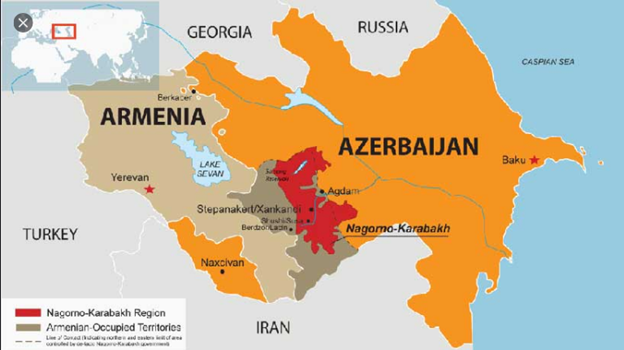
- In international news, the border conflicts between Armenia and Azerbaijan, as is true in other parts of Eurasia, are holdovers from their previous existence as part of the old Soviet Union — A Historic Azerbaijan–Armenia Peace Deal and the Corridor That Changes Everything; By John Spencer (@SpencerGuard). By John Spencer and Liam Collins | com/SpencerGuard | 9:27 PM · Aug 8, 2025. TAGS: Azerbaijan, Armenia, Nagorno-Karabakh, Trump Route for International Peace and Prosperity (TRIPP), Nakhchivan (Azerbaijan), President Trump,
- Today’s announcement of a peace agreement between Azerbaijan and Armenia, made possible by President Trump, is nothing short of historic. For nearly forty years, [ever since their independence from the USSR,] the two nations have fought bitter wars and lived under the shadow of unresolved hostilities over Nagorno-Karabakh. …
- The agreement signed at the White House is more than a pledge to stop fighting. It commits both sides to cease hostilities, establish full diplomatic relations, and respect each other’s territorial integrity. It also dissolves the long-standing OSCE Minsk Group, which was co-chaired by the United States, France, and Russia, and included member states such as Belarus, Germany, Italy, Sweden, Finland, and Turkey. Created in 1992 to mediate the conflict, the group never delivered a lasting peace.
- The deal also clears the way for U.S. defense cooperation with Azerbaijan. Most importantly, it establishes a 43-kilometer transit link through southern Armenia known as the TRIPP — the Trump Route for International Peace and Prosperity. This corridor connects mainland Azerbaijan to its Nakhchivan exclave, a separate part of the country southwest of Azerbaijan proper, bordered by Armenia, Iran, and Turkey. From Nakhchivan, direct road and rail lines lead into Turkey, with onward access to Europe and Mediterranean ports.
- This seemingly short stretch of land is the key to a much larger transformation. TRIPP is expected to unlock an estimated 45 billion dollars in energy and infrastructure opportunities by creating a secure, continuous route for pipelines, freight rail, and fiber-optic networks that physically link Europe, Asia, and the Middle East.
- For Azerbaijan, it is a decisive change. Oil, natural gas, refined products, and goods can move directly west into Turkey without passing through Georgia or Iran. This provides redundancy alongside the existing Baku–Tbilisi–Ceyhan [PRON.: chay-HAN] and Southern Gas Corridor pipelines, increasing both capacity and security for exports.
- The U.S. will lift restrictions on defense cooperation with Baku when the administration issues a waiver to a section of the Freedom Support Act of 1992, which has prohibited direct assistance to Azerbaijan due to its disputes with Armenia.
- For Armenia, the corridor promises infrastructure investment, new trade flows, and economic integration after years of isolation. Yerevan [Armenia’s capital] has agreed to grant the United States exclusive special development rights to the Zangezur Corridor land for 99 years. The U.S. will sublease the corridor to a consortium tasked with developing rail, oil, gas, and fiber-optic lines, and potentially electricity transmission along the 27-mile route.
- For Turkey, TRIPP strengthens its position as a vital energy and logistics hub bridging Europe, Asia, and the Middle East. Strategically, the corridor bypasses Iranian territory entirely, cutting Tehran out of valuable transit revenues and removing a major source of political leverage over Baku [Azerbaijan’s capital].
- It also sidesteps Moscow’s ability to control Caucasus trade and energy routes, creating a U.S.-brokered, Turkey-linked pathway that operates outside Russian influence. By reshaping how energy, goods, and information move through the region, TRIPP weakens two of Washington’s principal geopolitical rivals while reinforcing NATO’s southeastern flank.
- The broader context makes this achievement even more significant. This is not a symbolic handshake for the cameras. It is the culmination of years of shifting realities on the battlefield and in the marketplace, now formalized into a structural change in the region’s physical and political landscape.
- The peace agreement removes the immediate risk of renewed war, while the corridor reduces the incentive for either side to return to conflict by making cooperation both profitable and necessary. The economic payoff is clear, the strategic benefits are considerable, and the precedent that American diplomacy can still redraw geopolitical maps is undeniable.
- For those of us who have walked the battlefields of Nagorno-Karabakh, spoken to its survivors, and studied the cost of decades of conflict, today’s announcement is more than a diplomatic milestone. It is a rare moment when peace, profit, and strategy align — and one the world should pay far more attention to, because its impact will ripple far beyond the mountains of the South Caucasus.
- There’s a piece from Reuters that gives some more context on how this will play out. I’ll read it in a substantially excerpted form and then comment — Iran threatens planned Trump corridor envisaged by Azerbaijan-Armenia peace deal; By Parisa Hafezi and Andrew Osborn | REUTERS.COM | August 9, 2025@11:51 AM CDT/Updated 8 hours ago. TAGS: Iran, Caucasus corridor, Armenia, Azerbaijan, Armenia, Trump Route for International Peace and Prosperity (TRIPP), Nakhchivan (Azerbaijan), Turkey,
- [Iranian media reported that] Iran threatened on Saturday to block a corridor planned in the Caucasus under a regional deal sponsored by U.S. President Donald Trump, raising a new question mark over a peace plan hailed as a strategically important shift.
- A top Azerbaijani diplomat said earlier that the plan, announced by Trump on Friday, was just one step from a final peace deal between his country and Armenia, which reiterated its support for the plan. …
- The U.S. would have exclusive development rights to the corridor, which the White House said would facilitate greater exports of energy and other resources.
- It was not immediately clear how Iran, which borders the area, would block it but the statement from Ali Akbar Velayati, top adviser to Iran’s supreme leader, raised questions over its security.
- He said military exercises carried out in northwest Iran demonstrated the Islamic Republic’s readiness and determination to prevent any geopolitical changes. …
- Analysts and insiders say that Iran … lacks the military power to block the corridor. …
- Russia, a traditional broker and ally of Armenia in the strategically important South Caucasus region, which is crisscrossed with oil and gas pipelines, was not included, despite its border guards being stationed on the border between Armenia and Iran.
- While Moscow said it supported the summit, it proposed “implementing solutions developed by the countries of the region themselves with the support of their immediate neighbours – Russia, Iran and Turkey” to avoid what it called the “sad experience” of Western efforts to mediate in the Middle East.
- Azerbaijan’s close ally, NATO member Turkey, welcomed the accord. …
- There remained only one obstacle, said [Azerbaijan’s ambassador to the UK Elin] Suleymanov, which was for Armenia to amend its constitution to remove a reference to Nagorno-Karabakh. …
- [Armenian Prime Minister] Pashinyan this year called for a referendum to change the constitution, but no date for it has been set yet. Armenia is to hold parliamentary elections in June 2026, and the new constitution is expected to be drafted before the vote. …
- Asked when the transit rail route would start running, Suleymanov said that would depend on cooperation between the U.S. and Armenia whom he said were already in talks.
- Joshua Kucera, Senior South Caucasus analyst at International Crisis Group, said Trump may not have got the easy win he had hoped for as the agreements left many questions unanswered.
- The issue of Armenia’s constitution continued to threaten to derail the process, and it was not clear how the new transport corridor would work in practice.
- [Said Kucera,] “Key details are missing, including about how customs checks and security will work, and the nature of Armenia’s reciprocal access to Azerbaijani territory. These could be serious stumbling blocks.”
- [Azerbaijan’s ambassador to the UK Elin] Suleymanov played down suggestions that Russia, which still has extensive security and economic interests in Armenia, was being disadvantaged, [saying,] “Anybody and everybody can benefit from this if they choose to.”
- MIKE: These stories have so many aspects, that all this could easily have been titled, “The Good, the Bad, and the Ugly”.
- MIKE: “The Good” is a peace treaty between two countries that seemed for decades to have irreconcilable differences. Their conflicts were due to messy USSR-era borders, plus religious and ethnic differences rooted in centuries of history.
- MIKE: Some listeners might wonder what the difference is between the Nagorno-Karabakh dispute that was ultimately resolved after a fashion by Azerbaijan in their last war, and Azerbaijan’s exclave of Nakhchivan on Armenia’s southwest border, and it’s a good question.
- MIKE: Nakhchivan is an internationally recognized exclave of Azerbaijan. That is to say, it’s part of Azerbaijan even though it shares no contiguous border with Azerbaijan. It’s not unlike Alaska not being contiguous with the Lower 48 States but still being part of the US.
- MIKE: Nagorno-Karabakh, on the other hand, was and is an internationally recognized part of Azerbaijan’s territory. It was majority-inhabited by ethnic Christian Armenians who didn’t want to be governed by Muslim-majority Azerbaijan.
- MIKE: The enclave declared its independence from Azerbaijan in 1994. The only country that recognized that independence was Armenia.
- MIKE: Azerbaijan’s attack on and conquest of Nagorno-Karabakh in 2023 was tragic, but based on international law, it was a legal reoccupation of their own breakaway territory.
- MIKE: “The Bad” is that while this treaty might be a huge step forward, it could still be stymied if Armenian voters don’t approve the constitutional change that removes mention of Nagorno-Karabakh from their constitution. Approval of this change by voters is not a given since feelings in Armenia still run high on this issue.
- MIKE: There is also the matter of hostility to the agreement by bordering countries that have both economic and significant geopolitical concerns of potentially major changes in the region.
- MIKE: Russia and Iran in particular might be extremely unhappy about the US’s insertion of itself into their geopolitical backyards. This might end up being expressed in unpredictable ways that could create new areas of conflict and friction in the region.
- MIKE: “The Ugly”, of course, is Trump and his ego, and how it reflects on the United States’ involvement in this treaty.
- MIKE: The first ugly fact is that Trump managed to get his name on this “proposed Trump Route for International Peace and Prosperity”. There is also a question of what he promised to these two countries in order to accomplish that. His name will probably be laminated onto a gold sign every kilometer of the route.
- MIKE: But perhaps the ugliest aspect of this corridor is the 99-year lease that Trump extracted in the deal for exclusive US economic development rights that will be sublet for a price to other bidders and consortiums. It smacks of the deal cut by the British East India Company that ultimately led to it effectively being the mercantilist occupier of the Indian subcontinent, and that history is really ugly.
- MIKE: If this agreement is fully realized for Armenia, Azerbaijan, and the US, it could be highly advantageous to all three, with the US especially having won insertion into the region in a significant economic and geopolitical way. Whether this will become a Pyrrhic victory for the US remains to be seen.
- MIKE: Is this really a good thing for the US? This is a part of the world that is in frequent turmoil and conflict. I see it as only a matter of time until the US inserts forces into this corridor to “defend its national interests”, much as Britain did in India. And that could get pretty ugly.
- MIKE: For those who want to learn more about this story, I’ve not only linked to the original articles. I also did some research for it and have embedded links if you want to explore further, and there will also be a map of the region. It’s all in the show post at ThinkwingRadio-dot-com.
___________________________________________________________
- Make sure you are registered to vote! VoteTexas.GOV – Texas Voter Information
- It’s time to snail-mail (no emails or faxes) in your application for mail-ballots, IF you qualify TEXAS SoS VOTE-BY-MAIL BALLOT APPLICATION (ALL TEXAS COUNTIES) HarrisVotes.com – Countywide Voting Centers, (Election Information Line (713) 755-6965), Harris County Clerk
- Obtain a Voter Registration Application (HarrisVotes.com)
- Harris County “Vote-By-Mail’ Application for 2023
- Austin County Elections
- Brazoria County (TX) Clerk Election Information
- Chambers County (TX) Elections
- Colorado County (TX) Elections
- Fort Bend County takes you to the proper link
- GalvestonVotes.org (Galveston County, TX)
- Harris County ((HarrisVotes.com)
- LibertyElections (Liberty County, TX)
- Montgomery County (TX) Elections
- Walker County Elections
- Waller County (TX) Elections
- Wharton County Elections
- For personalized, nonpartisan voter guides and information, Consider visiting Vote.ORG. Ballotpedia.com and Texas League of Women Voters are also good places to get election info.
- If you are denied your right to vote any place at any time at any polling place for any reason, ask for (or demand) a provisional ballot rather than lose your vote.
- HarrisVotes.com – Countywide Voting Centers, HARRIS COUNTY – IDENTIFICATION REQUIRED FOR VOTING: Do not possess and cannot reasonably obtain one of these IDs?
- Fill out a declaration at the polls describing a reasonable impediment to obtaining it, and show a copy or original of one of the following supporting forms of ID:
- A government document that shows your name and an address, including your voter registration certificate
- Current utility bill
- Bank statement
- Government check
- Paycheck
- A certified domestic (from a U.S. state or territory) birth certificate or (b) a document confirming birth admissible in a court of law which establishes your identity (which may include a foreign birth document)
- You may vote early by-mail if:You are registered to vote and meet one of the following criteria:
- Away from the county of residence on Election Day and during the early voting period;
- Sick or disabled;
- 65 years of age or older on Election Day; or
- Confined in jail, but eligible to vote.
- Make sure you are registered:
- Ann Harris Bennett, Tax Assessor-Collector & Voter Registrar
- CHECK REGISTRATION STATUS HERE
- CLICK How to register to vote in Texas
- Outside Texas, try Vote.org.
- BE REGISTERED TO VOTE, and if eligible, REMEMBER TO FILL OUT AND MAIL NEW MAIL-IN BALLOT APPLICATIONS FOR 2023.
- Obtain a Voter Registration Application (HarrisVotes.com)
- Just be registered and apply for your mail-in ballot if you may qualify.
- You can track your Mail Ballot Activity from our website with direct link provided here https://www.harrisvotes.com/Tracking
_______________________________________________________
Remember! When you donate to KPFT, your dollars pay for:
- Transmitter and equipment costs
- Programs like Thinkwing Radio, Politics Done Right, and other locally-generated political talk shows
- KPFT’s online streaming
- Maintaining a wide variety of music programs
Each time you turn on the radio, you can hear your dollars at work! Make your contribution to this station right now. Just call 713 526 5738. That’s 713-526-5738. Or give online at KPFT.org! 
Discover more from Thinkwing Radio with Mike Honig
Subscribe to get the latest posts sent to your email.
