I admit it. I yielded to the hype and the ‘sturm und drang’ and decided to catch an episode of the MTV series, “Skins”.
It was not at all what I expected. It’s actually much deeper than perhaps it has a right to be. Continue reading

I admit it. I yielded to the hype and the ‘sturm und drang’ and decided to catch an episode of the MTV series, “Skins”.
It was not at all what I expected. It’s actually much deeper than perhaps it has a right to be. Continue reading
By Matt Feeney, Posted Friday, Jan. 14, 2011, at 11:22 AM ET
See Slate’s complete coverage of the Gabrielle Giffords shooting and the arrest of Jared Lee Loughner.

Friedrich Nietzsche
If we never discovered that Jared Lee Loughner honed his murderous outlook while sitting alone in his bedroom, reading Nietzsche and thinking about nihilism, that would have been real news. Instead of real news, though, we’ve gotten a dreary iteration of a cultural cliché. The New York Times and other media are saying the addled and alienated young man arrested for trying to assassinate Gabrielle Giffords, and for the murders of 9-year-old Christina Taylor Green and five other people, took himself to be a Nietzschean. Of course he did. Continue reading
Sometimes I have lots of stuff I want to share, but it’s not reasonable to create a new post for each, so this will be my first potpourri post. Continue reading
I know this piece makes me kind of a fan-boy, but I admit it. I’m one of probably millions of people who are more saddened than words can describe to see Keith Olbermann leave MSNBC.
That’s the bad news. Keep reading for the possible silver lining. Continue reading
Maverick Economist Alfred Kahn has a penchant for candor that is both refreshing and dangerous in Washington. When he said that there is the possibility of a “deep, deep depression” if inflation continues to soar, the President was furious. Kahn responded by purging the word depression from his vocabulary and instead using “banana.” So he now says: “We’re in danger of having the worst banana in 45 years.”
– Business: Yes, We Have No Bananas (http://www.time.com/time/magazine/article/0,9171,919922,00.html)
Words have power. That’s why an ad slogan is so persuasive. It’s why people polish speeches. It’s why society sometimes considers words taboo.
Sometimes, words are taboo for politically expedient reasons. Economist Alfred Kahn learned this when he felt forced to substitute the word “banana” for the word “depression”. Continue reading
One would think that after Bush dismissed the “Bin Laden Determined to Strike Inside the United States” intelligence memo in August of 2001, Republicans might have learned that ideologically inconvenient intelligence should not be ignored just because it’s, well, ideologically inconvenient.
And you’d be wrong. Continue reading
You want to know the biggest problem with “All You Can Eat” restaurants? Well, it’s that you eat all you bloody well can!
Did you know that Klingon is the 2nd most spoken artificial language in the world after Esperanto?
On MovieMorlocks.com (accessed from Turner Classic Movies’ TCM.com), I ran across an interesting discussion entitled, “Did Groucho kill Harpo?”
While not the title I might have chosen, it’s an interesting discussion about the transition from silent to sound, and from silent comedy to sound comedy. While the piece has its flaws (mentioning many movies without the years they were made, and occasionally rambling a bit off point), it’s an interesting thought article on the transitions caused by technology, current events and changing public tastes.
Included in the article is a link to a very early color talkie from about 1900!
Find it here.
Talk of Mars exploration has always revolved around how to get there and back. What if we eliminated the “and back” part of that equation?
The mission certainly gets cheaper, but what are the chances of crew survival? And would anybody want to go on a one-way trip to a lace more than 35 million miles from home? Sometimes a LOT more than 35 million miles! Continue reading
13-Jan-2012: This story, Lender Shies Away From Slumping Sears, is just one of many negative foreshadowing stories about Sears in the news recently. It reminded me of this piece, which I originally published December 28, 2010.
____________________________________________

Sears & Roebuck: Old & Tired?
Sears & Roebuck was once this country’s Walmart.
When I was a kid, going to the Sears store on Bedford Avenue in Brooklyn was a great adventure. The first thing you noticed when you walked into the store was the smell; it was popcorn, warm cookies and candy from the sweets counter in the middle of the aisle. It made the shopping experience there more like a party than a retail excursion. Continue reading
For years now, I’ve felt that the real FoxNEWS slogan should be, “We distort, you decide.” Now there’s proof that it’s probably the truest thing that FoxNEWS could say about itself, if only the network would “man-up”.
Now there’s proof that my gut (and a lot of well-informed guts out there in the news-reporting and -consuming public) were Delphic in their prognosticatory accuracy. Continue reading
I’m kind of a news junkie. That’s why I post links to so many articles on this website. I’m also very picky about accuracy and facts. That’s why any article I post that sounds … peculiar … is something I’ll research first before wasting your time with it.
So when I saw this headline from ThinkProgress.org – TX GOP Official Opposes Jewish House Speaker: Christians ‘Are The People That Do The Best Jobs’ – I wanted to find and verify its source. Continue reading
When politics generally and Republican/Rightwing policy proposals make you want to rip your hair out, read Truman’s “Give ‘Em Hell” speech (Oct 1, 1948) today, and be inspired. www.trumanlibrary.org/publicpapers/index.php?pid=1973
This believed to be the speech that turned the 1948 election for Harry Truman.
It took me about 2 hours to find an authoritative source for this transcript, so I can vouch for its accuracy.
The speech was given in Charleston, West Virginia. Here’s the text: Continue reading
Those of you who follow movies and movie reviews have certainly heard of Roger Ebert. You’ve also probably heard of the health trials he’s experienced in the past few years, culminating in the loss of his voice.
I’ve been following Roger Ebert on Twitter for the past several weeks. He generates a lot of tweets. Initially, I wondered if they would overwhelm my patience. It seemed like Roger generated a lot of ‘stream of consciousness’ tweets. I soon wondered if maybe I should follow more people who are equally interesting, but who tweet less often. Sort of a quality/quantity consideration.
As these thoughts went through my mind over the past several weeks, thinking about his circumstances and continuing to read his tweets, I decided that the quality was worth the quantity. I thought a lot about the frustrations he must feel; such a talkative man losing the power of speech. Continue reading
I love history. I think it’s particularly fascinating when you can almost imagine yourself in the past because a scene is presented so vividly, and nothing does that with more power than film or photos from a long-ago time.
Below are four links that I’ve collected and put in the History tab of ThinkWingRadio.com.
_______________________________
Vladimir Putin can make this statement thanks exclusively to the Bush/Cheney Admininstration.
[A]sked about the 10 Russian “sleeper agents” caught in the US in June and later deported to Moscow. Putin claimed that they had not harmed US interests, adding: “The methods employed by our special services differ in a good way from those used by US special services. Thank God, neither the agents in question or any other Russian intelligence officers are known to have been involved in creating secret prisons, kidnappings, or torture.”
– http://www.guardian.co.uk/world/2010/dec/02/us-embassy-cables-itvinenko-putin
So the question again remains: When will this nation have the courage to clear its good name and indict our homegrown war criminals?
“ATLANTA — The Civil War, the most wrenching and bloody episode in American history, may not seem like much of a cause for celebration, especially in the South.
“And yet, as the 150th anniversary of the four-year conflict gets under way, some groups in the old Confederacy are planning at least a certain amount of hoopla, chiefly around the glory days of secession, when 11 states declared their sovereignty under a banner of states’ rights and broke from the union.”
Readers interesting, sad and scary comments can be found here.
When only 20, Danish astronomer Tycho Brahe lost a chunk of nose
Tim Strawn, the ‘villain of the piece’ in “Cat Ballou
;)
It’s interesting (to me ;) to note that the role Leslie Nielsen auditioned for in “Ben Hur” was the one that eventually went to Stephen Boyd.
I never much cared for Boyd as an actor, and have no idea how he got so much work in the 1960s. He’s wooden and uninteresting to watch. I speculate that he got selected over Nielsen for at least three reasons:
1) He looks meaner,
2) He’s generally darker complected with dark hair,
3) Nielsen’s coloring was too much like Charlton Heston’s, thus not distingushing them sufficiently when they were in the same scenes.
Nielsen looked more nothern European and, frankly, looked too nice to be chopping up Ben Hur’s wheels in the chariot race.
Maybe if he’d dyed his hair and sneered more in the screen test …
Have you or your kids ever written a research paper for school? Were you crushed with work and fearful of not making the deadline? Were your research skills poor, or is English your second language?
Have you ever wished, however briefly and however wistfully, that you could just give it to someone else to do for you?
Read this article, and wonder how many of the other kids felt the same … And messed up the ‘curve’ because they could afford to do something about it.
Interesting article from Forbes via MSNBC.
The best and worst gift cards (if that’s not in itself an oxymoron). Click on the article link, and also go the the website they researched.
Dealing with the best and worst gift cards: http://www.msnbc.msn.com/id/40382786/ns/business-us_business/
 posted Sep 5th 2009 8:45AM (Engadget.com)
The fundamental tenet of ThinkWing Radio is that “Education is a prerequisite for a democracy.”
The article below is one of a pair that I’m posting, because I see them as steps away for this ideal rather than toward it. I believe that they are classic examples of seriously misguided attempts at being ‘leaders’ in the use of educational tools in the information age which will contribute to further degrading our already teetering public (and even private, apparently) educational system in this country.
Culling out-of-date books from a library is a reasonable and useful practice. Science books from 1995 would be a good example of books that are in dire need of updating.
But the dismantling of a library of books, and replacing it with a few computers, lots of e-books and a for-profit coffee shop?! (Yes, it’s run by students, but the idea is still to make a profit off of other students, at the expense of library space.)
Let’s not even talk about the wrongheadedness of addicting kids to caffeinated coffee!!
This article and the one I’m posting after it make some good points about why these ‘upgrades’ are bad ideas: Not everyone has a laptop; not everyone has internet at home; not everyone has a Nook, or Kindle, or whatever. I’ll make some others: Not all worthwhile books are available as e-books; many worthwhile out-of-print books are now available only in the old print versions remaining in libraries.
Last year I wrote an article for TGDaily.com which addressed other concerns I have about the current state of e-books.
I don’t know how we can prevent these seriously misguided ‘educators’ from taking us down this road, but someone needs to figure out a way.
Mike Honig
PS: I suggest going to the actual article to read some of the comments. I’ve included one below The range from informed and thought-provoking to frightening.
_______________________________
http://blogs.houstonpress.com/hairballs/2010/11/lamar_highs_library_ousts_book.php
By Margaret Downing, Tue., Nov. 23 2010 @ 9:00AM

We love the smell of burning literature in the morning.
Just adding a coffee shop to a neighborhood library so people can feel like they’re in Starbucks and ultra hip was apparently too passe a trend for Principal James McSwain of Lamar High School.
Finishing up a week ago, McSwain has thrown out nearly all the books and filled the space they were unnecessarily taking up with couches and coffee and food and told his students that they can access the exciting world of reading through e-books! And if they don’t have a laptop of their own and Internet access to do so, they can use one of the laptop computers in the library coffeeshop!
He’s even expanded the library coffeeshop hours to 6:30 a.m. to 6:30 p.m. which works great if you’re one of those kids with your own transportation and not one who is too young, too poor or with rotten parents who won’t let you drive to school yourself rather than riding the bus.
And he’s bought 35 new laptops! For a Houston ISD flagship school with more than 3,000 students in it.
A veteran educator who visited the school a few weeks ago said most of the books were already gone by then. “There were a few down one side. They assured me they’re getting rid of those as soon as they could. The plan is to turn the whole space into a coffee shop run by students.”
Students will be able to access places online such as Questia, an online resource facility where you can get articles about anything that you want, she told Hair Balls. There’s books online, too, but as she put it, the selections are limited. Her reaction:
“I was appalled. I was stunned by the whole thing I can’t imagine what he was thinking. I’m assured this is old school thinking and we should just appreciate that they’re not old school thinkers.”
The change, she said, was “designed to impress the new superintendent [Terry Grier] with the forward thinking nature of that particular principal at that particular school. ”
She said she was told one teacher who had kids after school working on their volunteer hours was asked to send them to the library to “get rid of the books.” She said he asked what they meant and “They said they didn’t care; just get them out of here.”
“He couldn’t bring himself to throw away books. He said it didn’t seem like a good thing for the kids to do. They got somebody [else]. My impression was that most of the books were thrown away. Some of them may have been donated.”
Hair Balls tried to reach McSwain; he would only speak to us through HISD Sarah Greer Osborne. This is what she told us:
“The school library has been updated. It’s got a lot of new electronic equipment. Most of it’s e-books and new laptops and they’re putting their money, instead of into paper, they’re putting it into electronic resources.Yes, there are still books there but most of it is now e-books where the kids can check out the book and as long as they have Internet access they can read the book. The library is now open from 6:30 to 6:30, a.m. to p.m., and he says the kids are eating it up; they have never seen so many kids in the library before. They only did this a week ago and he says the number of e-books being checked out is through the roof.
He says the kids love it. They did put coffee and food in there so the kids when they’re staying after school and before the kids can have a little coffee, read a book it’s just like Starbucks. Except they’re providing the books as well. The kids are eating it up that’s what they want. They want the e-books.”
The veteran teacher wasn’t as excited. “It’s just stupid. It just boggles the mind. I’m sure there’s more to the story and I’m sure that they can make it sound better than I’m making it sound to you but in the end it’s a terrible story. There’s no way in my mind that you can gloss this story and make it seem like a good idea.
“There’s no way to get hold of a book on the campus to read for pleasure or to use to write a paper. If you don’t have access to a computer of your own then you have to compete for one of the computers that are in the coffee shop. And you have to find a way to get it done during the time the coffee shop is open.”
The teacher said the whole thing breaks her heart; but she can walk away from it. At least she’s not the Lamar High librarian, whose library has been “repurposed” (a favorite educator buzzword these days), presiding over a coffee shop with all those swell couches.
Tags: books, HISD, Lamar High School, library, Terry Grier
_________________________
Supplemental Links:
Emily says: Here is a piece on the project from the River Oaks Examiner. This provides some insight from the library about why the change is being made. http://www.hcnonline.com/river_oaks/news/article_74f77bcc-f737-5a57-a35d-1344b89227c5.html
As a librarian I completely understand the need to provide more access to ebooks. Similar projects have occurred at private institutions http://www.engadget.com/2009/09/05/boston-prep-school-nixes-all-the-books-in-its-library-replaces/ – The difference being that these schools may provide better access to the equipment needed to use electronic materials.
This discussion about the need or desire to switch to only electronic resources is going on all over country in many different types of libraries.
It will be interesting to see how this project pans out. It can become a dangerous situation for librarians as our role as knowledge navigators is replaced by Google.
Posted On: Tuesday, Nov. 23 2010 @ 1:20PM
 As I promised on today’s show, this commentary includes graphics and links upon which I based this opinion. This is a slightly longer, more detailed version since I don’t have to worry about air time.
So you can do your own research and validate me … Or not. ;) Let me know what you think.
Thanks to Elizabeth, Scott and Greg for calling in and participating.
Mike
______________________________________
You’ve been hearing a lot lately about the end of the Bush tax cuts. You’ve also been hearing lots of different opinions on what we should do about it.
Extend it for everyone? Let it expire for everyone? Extend it for the middle class but not for the rich?
And then we get into, What is the middle class? What qualifies as rich? Where are the cut-offs? Who decides? Why should the rich pay a higher percentage of their income in taxes than the middle class, or the poor?
Once we’ve thrashed that around for a while, we get to ask, Do tax cuts stimulate the economy? How much? Who gets them? Is it better for the economy to give big cuts or small ones? Are there better ways to do it? Does cutting taxes for the rich really provide an incentive for them to create jobs?
And on and on, blah, bl-blah, bl-blah.
At the end of the day, this boils down to only one question that matters: What taxing and spending policies most benefit America and the greatest number of Americans?
As you listen to this, it’s going to sound like I just want to beat up the rich with taxes, but there’s a punch line at the end that literally changes the equation.
Let’s start with some basics. And I’ll be providing links to my sources when I post this commentary on my website, ThinkwingRadio.com, so you can check them out yourself.
According to the U.S. Census, 2009 median income by state ranged from about $69,272 in Maryland to $36,646 in Mississippi. Average median for the U.S. was $49,777.
What qualifies as median income varies quite a lot depending on where you live in the United States. So based on the national Census figures, let’s call middle-income somewhere between $40k and $70k per year.
In a recently updated study, in the United States as of 2007, the top 1% of households owned 34.6% of all private wealth.
1% … 34.6% of all private wealth. In terms of financial wealth, the top 1% of households had an even greater share: 42.7%.
The next 19% had 50.5%. So, just 20% of the people owned 85% of all the nation’s wealth. These are a lot of numbers to digest on the radio, so I’ll repeat that: Just 20% of the American people owned 85% of all the wealth.
This left only 15% of the wealth for the bottom 80% of American workers. That same 80% owns only 7% of total financial wealth. Let me put this another way.
If you had a pizza that was divided up like this in front of five people, 4 of them would have to share about 1/2 of a slice. That’s how wealth is divided up in this country.
According to FactCheck.org and The Tax Policy Center, those reporting adjusted gross income of more than $250,000 are projected to make up about 2 percent of households in 2010. Adjusted gross is usually a lot less than actual earnings.
It is estimated that 2% will earn 24.1 percent of all income, and pay 43.6 percent of all personal federal income taxes.
Letting the current tax rates expire for those folks costs them nothing unless their adjusted gross income exceeds that $250,000 adjusted gross.
But you know what? While that’s all interesting, it’s actually a little besides the point. Here’s the point.
Rich people actually make more money when they pay a higher share of the tax burden. That seems counter-intuitive at first, but it makes sense when you think about it.
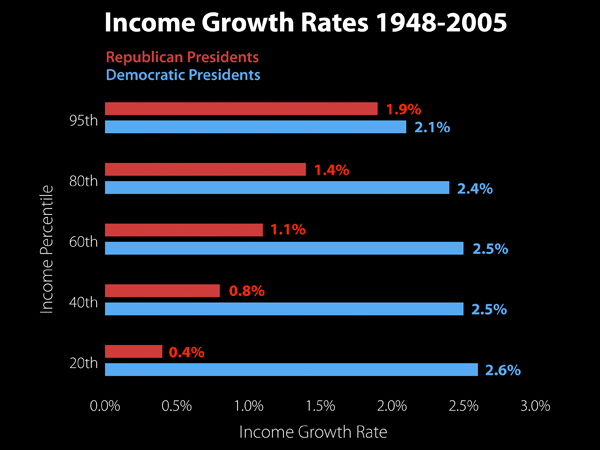
In a Slate.com article, Timothy Noah pulls together a lot of different sources of information into a very readable 40 page article that examines a lot of disparate data and reaches some very interesting conclusions. On Page 16 of the PDF version, there’s a particular chart based on work done by Larry M. Bartels at Princeton. I’m supplementing that chart with another which is more intuitively understood, which again will be on my website.
This data shows that under Democratic presidents, everyone makes more. Even the top 5% of earners whose marginal tax rates went up.
Reading the article, I don’t think that Noah risks suggestion as to why that is, but I think I will try.
There are lots of interesting and informative charts and graphs, but there is one that’s particularly interesting.
Under Republicans, tax rates tend to be less progressive. That’s to say that the rich pay a lower fraction of income as taxes, and that’s made up by higher taxes on people much further down the wealth chain. The result is that rich people have more money to slosh around (theoretically investing in new business and new jobs), but mostly put it into financial instruments, collectibles like art, and perhaps investments overseas.
Why? Because in spite of the Supply Side common wisdom, people in the lower 80% of earners just don’t have enough spending power for discretionary purchases. They hunker down. And that’s why Supply Side economics is a fundamentally flawed theory.
Rich people don’t invest money until there’s demand for whatever product or service they want to provide.
The 80% of cash-strapped Americans can’t create much new demand, so the rich bide their time and do other things with their money. The rich stay rich, buy don’t tend to get much richer because they have no customers. Most of them still save their money and invest it in economically non-productive assets like land, art, etc., perhaps even sending surplus assets overseas for international investments.
Under Democrats, everybody makes more money after taxes. The lower 80% of earners get a few more dollars in their checks every week, and they tend to spend it. The rich pay a few more dollars in taxes from their income, and are annoyed, but not much hurt.
But here’s the magic! Because rich people take more of the tax bullet for the average Joe, Joe has more money to spend. Joe buys gifts for the wife and kids. Maybe Joe can now qualify for a mortgage on a new small house or a modest car loan. Joe’s not feeling rich, but he feels like he’s got a little room to breathe, and so much stuff is wearing out, or the kids need new clothes and stuff. Joe is grateful to have the money to buy those things which will make his family’s life better. It’s called ‘pent-up demand’, and Joe’s got plenty of that.
So Joe, and his neighbor and his trash collector and his sales clerk all have a few more bucks every week, and they all have pent-up demand.
Rich people notice this. Their money has been pretty much parked in financial instruments with low-but-safe yields. Their stocks have been languishing, though, because the companies they own haven’t had any customers… Until after the middle class tax cut.
Suddenly, things are picking up. Store stocks are running a bit slow, so they place bigger orders which put’s more folks back to work, and they have their pent-up demand, and now the cycle has been flipped and is once again heading uphill.
What we see here is the fundamental failure of the Supply Side Model of economics. No entrepreneur will invest in a business until he sees potential demand. Customers with extra money in their pockets ARE that demand.
This might be called the “Rising Tides Lifts All Boats” side of economics.
Under Democratic leadership, taxation becomes more progressive, which is a nicer way of saying that the rich bite the bullet and take a larger share of the tax burden in the interests of the greater good.
On its face, on an abstract philosophical level, that seems unfair. But IS it unfair if the rich end up also making more money at higher tax rates?
Let me try to summarize this for you, but remember: I’m going to be posting all this online with my links and side notes. That way, if you want to dig deeper and reach your own conclusions, you can.
In the chart I have in front of me, over a span from 1948-2005, a span of 57 years, every income group did better under Democratic presidents, including the rich.
Under Democratic presidents, the highest 5% of earners made an extra 0.2%/yr.
And the reason that the rich did better by sharing more of the tax burden? Because their investments were worth more. Their businesses did better, so their stock prices went up. With increased business activity, their savings and financial instruments became worth more and their interest yields grew.
In this sense, taxes on the rich — whatever your views about the justice of a progressive tax system — turns out to be a good investment for the country AND the rich.
In 1953, GM President Charles Wilson was testifying before Congress for the position of Secretary of Defense. When asked a question about potential conflicts of interest, Wilson’s actual but frequently misquoted response was “… for years I thought what was good for the country was good for General Motors and vice versa”.
This is how we all have to see it, especially those with wealth who are understandably concerned about their taxes. “What’s good for America is good for the Rich, and vice versa.”
_____________________________________________________________
American Community Survey
Annual Social and Economic Supplement
Income, Poverty, and Health Insurance Coverage in the United States: 2009
Page 7 (PDF 12)
INCOME IN THE UNITED STATES
Highlights
http://www.census.gov/prod/2010pubs/acsbr09-2.pdf
American Community Surveys (ACS)
Real median household income in the United States fell between the 2008 and 2009 ACS— decreasing by 2.9 percent from $51,726 to $50,221. State estimates in the 2009 ACS ranged from $69,272 in Maryland to $36,646 in Mississippi.4 The median household incomes were lower than the U.S. median in 29 states and higher in 20 states and the District of Columbia. Wisconsin had a median household income of $49,993, which was not significantly different from the U.S. median.

